Decision Literacy
How to think clearly, evaluate choices, and understand consequences.
Free and open curriculum for ages 8–12
A kid-friendly systems curriculum that helps ages 8–12 notice body clues, understand what connected body systems are doing, and ask safer, kinder questions about health.
18 weeks of hands-on lessons — about 20 minutes per session — for classrooms, homeschool families, after-school clubs, and curious adults. Kids can draw, roleplay, use emoji scales, or answer out loud while they study body autopilot, food jobs, the body security team, night cleanup and repair, and a curiosity-driven Body Mystery Project.
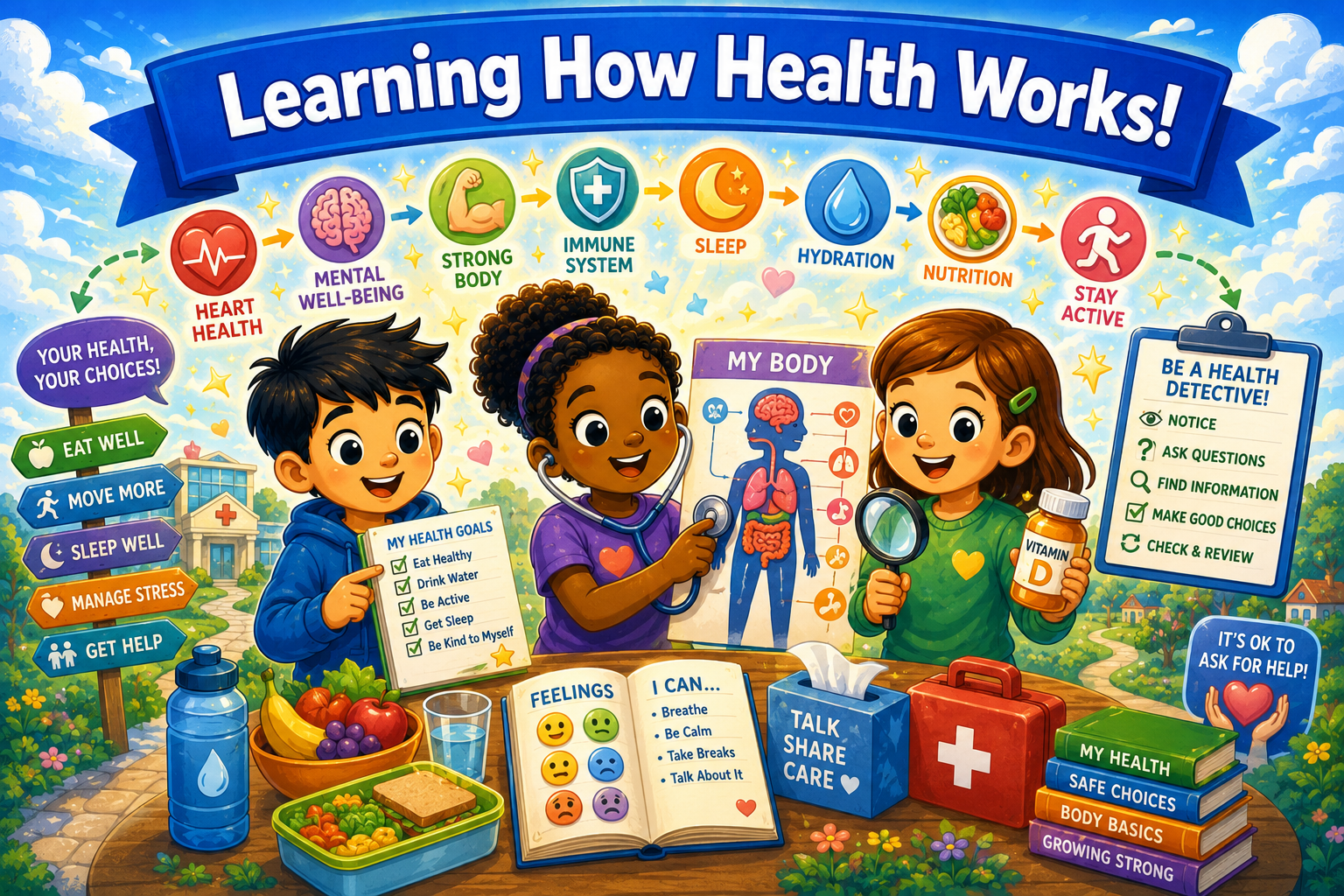
Health Systems Literacy for Kids is an 18-week curriculum for ages 8–12, built for classroom teachers, homeschool families, caregivers, and after-school leaders. Kids learn to notice body clues, ask what systems may be happening underneath them, and build science vocabulary without shame, panic, or pressure to optimize themselves. Drawing, roleplay, oral answers, emoji scales, and fictional examples all count.
Warm privacy reminder
Food, sleep, illness, mood, and body data never have to be shared publicly. Private and pretend examples are built into the curriculum from the start.
This curriculum is part of Literacy for Kids, a collection of open-source curricula designed to help children ages 8–12 understand the systems that shape the modern world.
How to think clearly, evaluate choices, and understand consequences.
How computers work and how to use technology responsibly.
How to find, interpret, and evaluate information.
How money and financial systems affect everyday life.
How societies organize themselves and how citizens shape communities.
How emotions, cognition, and social systems shape behavior and relationships.
How laws are built, how contracts work, and how disputes get resolved.
How planetary systems work and how human activity interfaces with them.
How the human body operates as an integrated system of feedback loops.
The curriculum is organized around big ideas kids can picture first, then connect to technical language when they are ready.
Kids learn that hunger, thirst, shivering, sleepiness, and other clues are part of the body autopilot story, not proof that a body is bad or failing.
Food is taught through jobs and patterns instead of good-food or bad-food labels, so learners can study energy and repair without shame.
The cleanup crew, repair crew, and memory librarian help kids picture sleep as active body work instead of empty downtime.
Walls, sticky traps, guards, messengers, and memory keepers make immune-system science easier to picture without the heavy jargon.
Students pick one safe body question, collect clues, and can share privately, partially, or with fictional examples. No change is a real finding.
The sequence moves from body autopilot and food jobs through the body's security team, body clock, night cleanup, and a curiosity-driven Body Mystery Project.
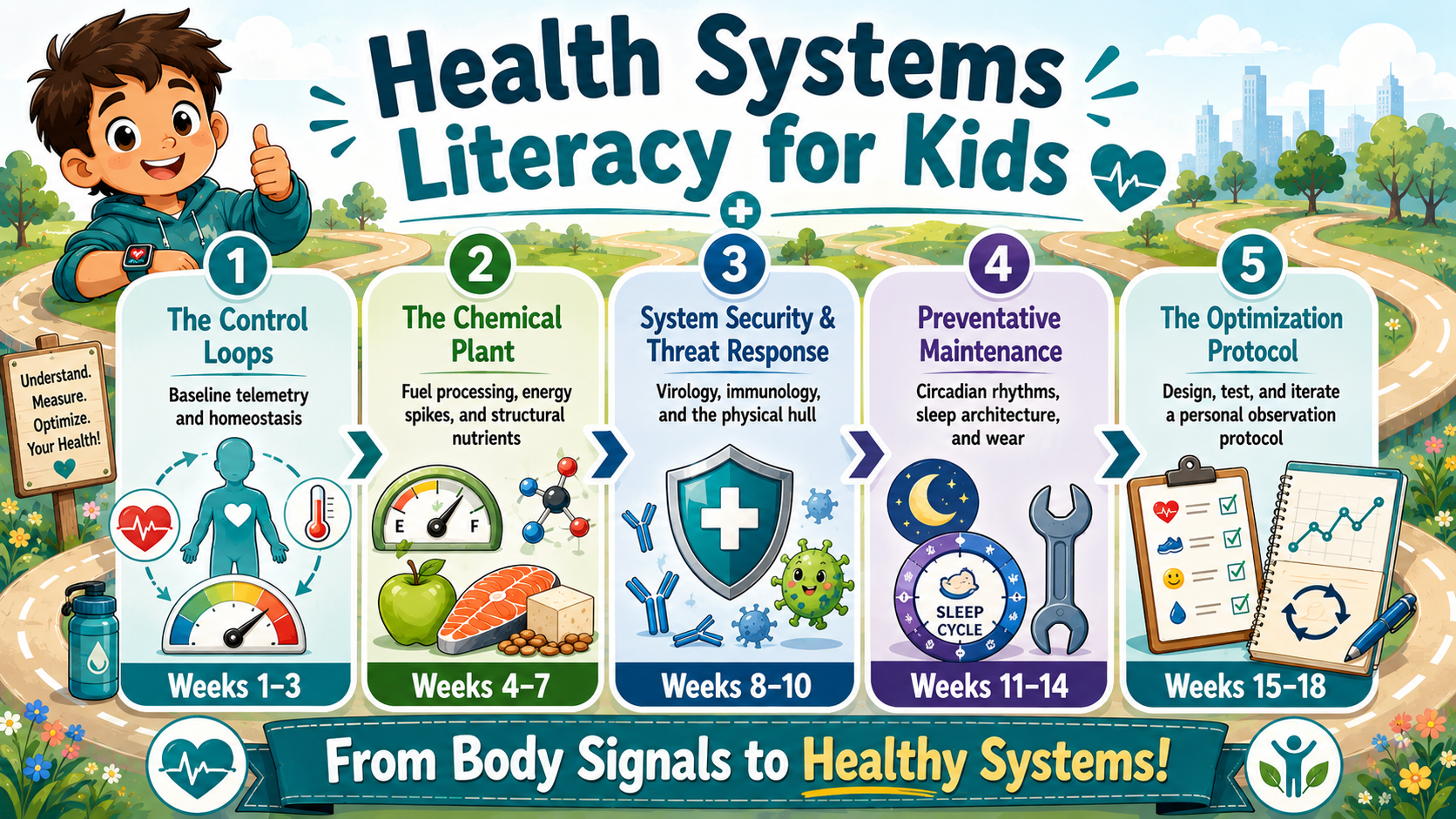
Weeks 1–3
Body clues, steadying loops, and heart calming-down checks
Weeks 4–7
The journey of one bite, food jobs, and gentle pattern detective work
Weeks 8–10
Protection, symptoms, and illness story maps
Weeks 11–14
Daily rhythm, night cleanup, gut helpers, and movement
Weeks 15–18
Pick a safe question, collect clues, and share what you discovered
Begin with the Welcome page, then move into Week 1. Private, fictional, drawing-based, and oral-response options are built in from the start.
Found a mistake or have a suggestion? Open an issue on GitHub.